

The Light We Cannot Resist
Moths, memory, and the patterns we fail to break

As a 12 year old, the ceiling light in my childhood home felt troubling. Every few months, no matter how well sealed it seemed to be, a small shadow would appear underneath. Dad would take it down, and when I’d peer inside I’d find another unfortunate gathering of moths had found their way inside and perished. I’d brush the fragments of antennae and wings into my palm, and apologetically toss it into the fishpond.
Most scientists believe moths fly into lights because it disrupts their natural instincts to fly with the moon and stars against their back. Artificial light confuses this instinct, so they spiral in erratic loops, circling and crashing again and again. They don’t know any better.
Humans are a lot like moths; we’re drawn to bright, shimmering things, often unaware of the potential for self-destruction.
From the impulses of phone addiction, to the incessant desire to innovate, our egoic need for power, money, control and accolades only makes the pattern continue. Almost always, someone flies too close to the light and the consequences are devastating; loneliness and disconnection, the exploitation of the vulnerable, and in more severe cases, the seismic disruption of environmental, cultural, or technological systems. Human’s are like moths, but unlike those sorry little insects, we should know better.
So why do we keep flying too close to the sun? We are aware of what the flame really is, but this awareness doesn’t protect us. If anything, it seems to coexist quite comfortably with our impulse to get closer.
One explanation is that humans are a species with a remarkably short memory. Every 100 years or so (when the witnesses of previous crises begin to die), societies become susceptible to boom and bust, growing inequality, and misplaced faith in easy solutions and phoney leaders. It’s why we see devastating wars every 100 years or so: WW1 & WW2, The American Civil War & Revolutionary Wars. These wars are easy to recognise and that’s part of what makes them so demoralising. We know the signs, we’ve seen the footage before, and still they return. Today, as the 2026 Iran conflict continues to escalate, the rest of us watch with a familiar mix of anger and helplessness, recognising the same patterns that have driven so many conflicts before.
Another explanation for our Promethian desire for the forbidden is that the danger changes form as history evolves. Each era is reshaped by its own disruptive forces - technologies and transformations that reorder how people live, think, and relate to one another faster than societies can fully comprehend. The printing press fractured authority and accelerated the spread of belief. The Industrial Revolution redrew class structures and concentrated wealth and power at unprecedented scales. Colonisation forced the collision and displacement of cultures across continents, the fallout of which we are still facing today. The twentieth century mechanised both production and destruction, while mass consumerism reshaped desire itself. The internet dissolved boundaries of information, truth, and identity. And now, artificial intelligence begins to challenge not only how we work, but how we define knowledge, creativity, and even reality.
Generational shifts in a society generate extraordinary progress, but they also produce instability, disorientation, inequality, and a vacuum in which simple answers become dangerously appealing. It’s not that we forget entirely; it’s that the context changes just enough to make old lessons feel inapplicable, obsolete or just plainly overlooked. Each generation inherits the consequences of transformation, but not always the wisdom to navigate it.


Seeking understanding through painting
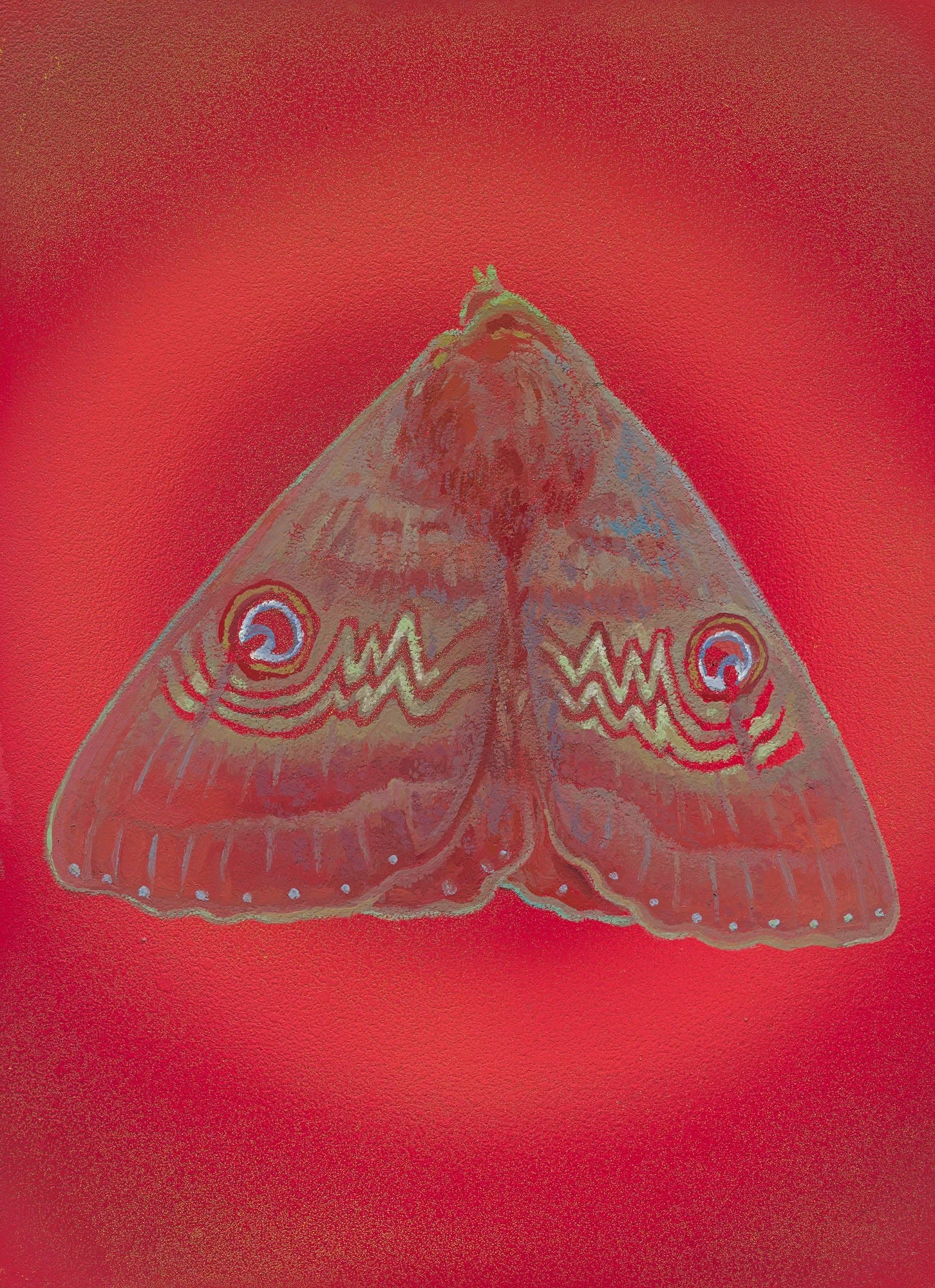
I’ve spent the last twelve months developing a new body of work inspired by this troubling amnesia that sees us flying again and again into a light that threatens to destroy us. Central to the body of work are 7 paintings of Southern Moon Moths, a beautiful, large species native to South, Western Australia with two big, blue-grey eye-spots. They’re particularly stunning, and hold a soft spot in my heart having grown up with them clung to the fly screens of our family home in the Perth Hills (fortunately, these were too big to get inside the lampshade).
The Southern Moon Moth series alternates between ombre-flame backdrops, and fragmented mountain peaks, with the moths overlaid in bleached out or x-ray-like shadows. The meaning here isn’t too complex; red and orange evokes light and mountain-peaks the pinnacle of achievement. But I wanted to push these visual motifs further too. For the flame moths, I recall stories of survivors and witnesses of nuclear detonations, who described how the light from the bomb was so intense, it rendered their arms and hands (held over their eyes), momentarily translucent. And for the ash moths, there is the fallout of the bomb, which bleached the victim’s onto pavements in Hiroshima and Nagasaki.
Making work for an exhibition, especially about subject matter of this nature, leaves me in an uncomfortable position. I’m not outside the pattern of pursuing the light. The same pull I’m trying to examine and critique is also what drives me to make the work in the first place. The desire to create something beautiful, to be recognised, to build something that endures beyond myself are not neutral forces. In fact, I feel a deep sense of responsibility as an artist to simultaneously push the boundaries of my creative and artistic potential, while staying accountable for the desires of my own ego.
It’s for this reason that I view my practice as a gift from a divine source separate to myself, rather than as an extension of the ego. Therefore, I feel devoted to doing the best job possible, regardless of the perception of others. That means making work that is beautiful and skillful but not necessarily always beautiful, because the goal is to make art that is heartfelt and real, rather than commercial. It’s a challenging role to tiptoe as an artist working with a commercial gallery, and trying to survive from my practice, but I’m grateful for the support at Linton and Kay for trusting me to make work that I truly believe in.
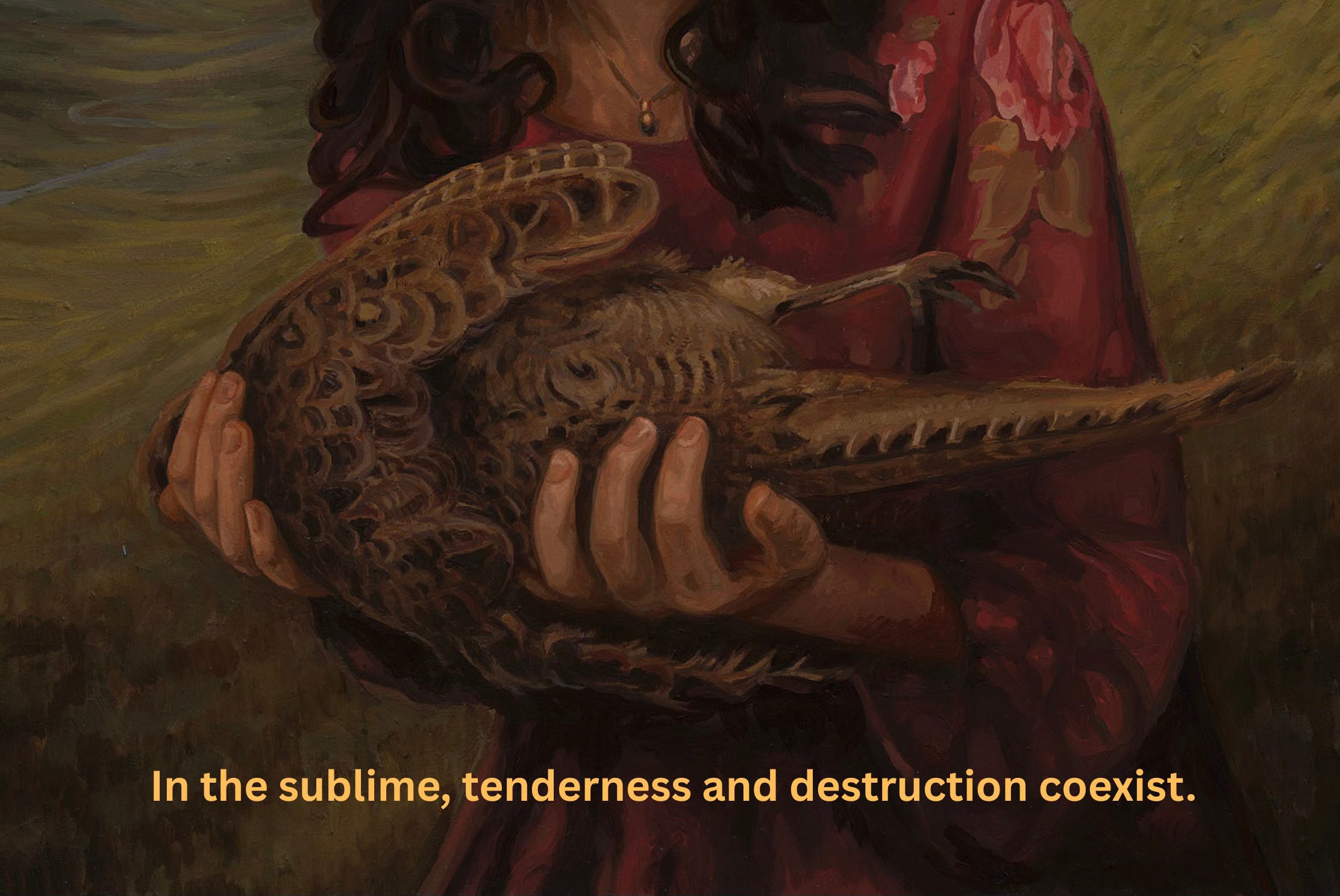
My portrait of Audrey holding a dead pheasant is not conventionally beautiful, but it captures the anguish of witnessing loss, mourning, and the destruction that follows when impulse carries someone too far.
Pheasants are game birds. I grew up with them scratching around the patio each morning when my family lived in the Dorset countryside. My nan often kept one in the freezer, and Dad would tell stories of boys from his school luring pheasants from the Blenheim estate onto their land so they could have them for dinner. I always thought they were beautiful.
On one of our walks through the local woodland, Dad and I found a dead barn owl laid out in a canola field. A small silver ring on its claw told us it was being tracked. Dad removed it and called the British Trust when we got home to report that one of their birds had died. I can’t remember whether it had been shot, but I do remember the occasional pop of shotguns echoing across the fields when we lived there.
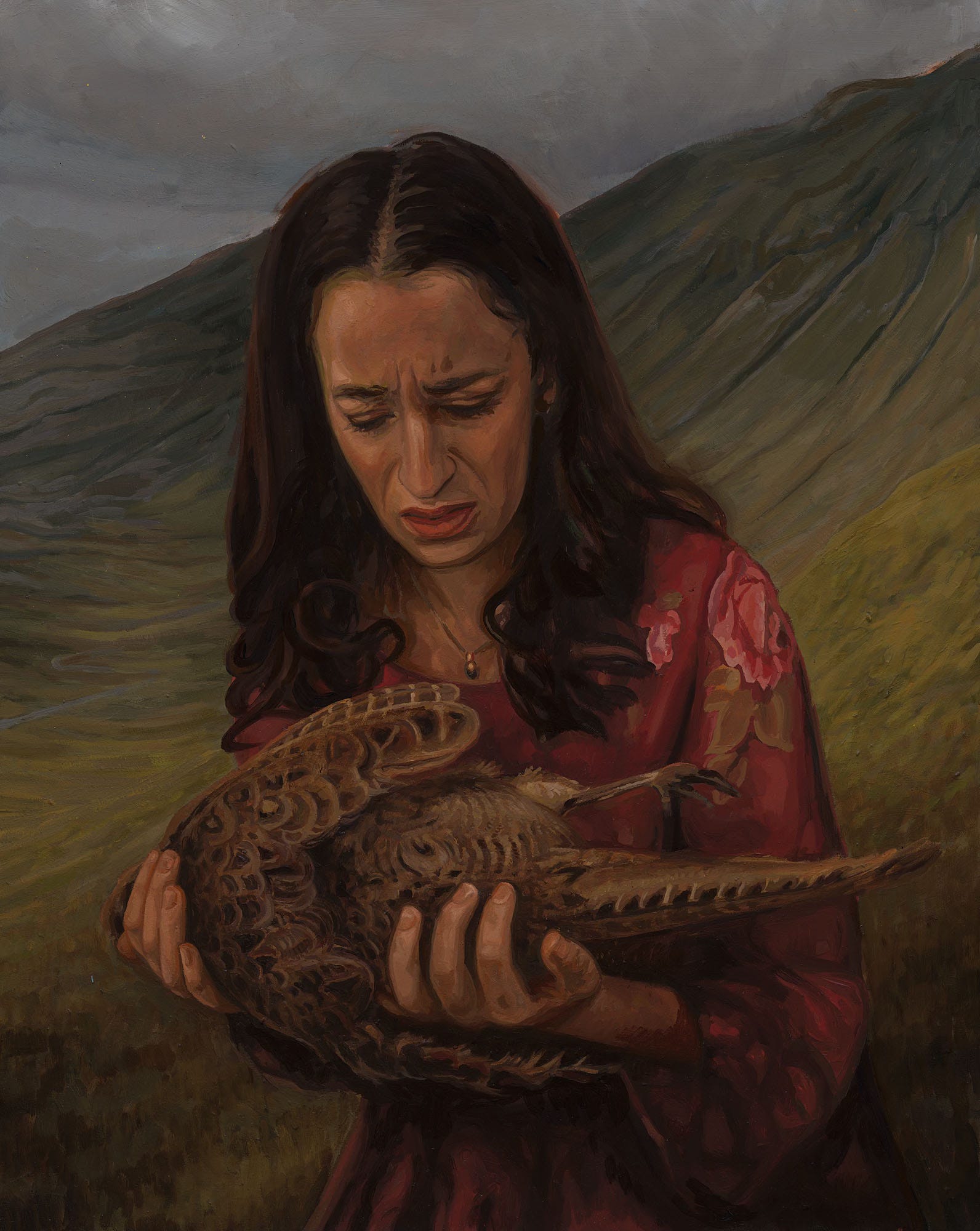
In creating this body of work, I am circling that same glow that disorients the moths in the journey through space: the pull of achievement, memory, and desire, and the way those forces both illuminate and consume my daily life. Each tiny moth painting was a kind of reckoning, a small attempt to hold still what is usually moving out of our control - the spiralling instinct to move toward light, even when we already understand what it does to us when we get to close. And in my painting of Audrey and the Pheasant, like so many others in the series, the grappling with memory, both real and imagined, suspended in new, surreal landscapes, are ways to make sense of the past and ongoing issues that continue to trouble all of humanity.
In this sense, the paintings in this exhibition are not complete stories but singular observations for you to hold: fragments of wings, traces of ash and fire, moments suspended mid-flight. And like the moths I once brushed into my palm and returned to the water, gobbled up by goldfish and frogs, they sit in my heart with both tenderness and unease, asking whether recognition alone is enough to interrupt the pattern - or whether we are, like them, doomed to be forever drawn back into the glow.
SAECULUM
Solo Exhibition by Melissa Clements
Linton and Kay Galleries, Subiaco
April 29 - May 18th, Opening April 30th, 2026.
Beautifully written, Melissa!
Beautifully written and so interesting. To be an artist is a great responsibility in many ways. I write poetry and music. Your paintings are amazing and I love reading the inspiration behind them